


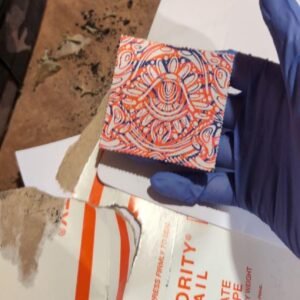



An Educational Overview of LSD Blotter Paper
LSD (Lysergic acid diethylamide) blotter paper is a common form in which the potent synthetic psychedelic substance is distributed. It consists of absorbent paper, often featuring intricate designs, that has been saturated with a liquid LSD solution and perforated into small individual squares, known as “tabs.“
A dose of 250 micrograms (μg) is considered a very strong and potentially overwhelming amount, far exceeding a typical standard dose, which often ranges between 50-150μg. For context, LSD is active at the microgram level, making it one of the most potent psychoactive substances known. A dose of this strength will produce an intense and long-lasting alteration of perception and consciousness.
The primary effects of LSD are caused by its action as a partial agonist at serotonin receptors (specifically the 5-HT2A receptor) in the brain. This alters normal neural communication, leading to the substance’s characteristic effects. The experience, often called a “trip,” can last 10-12 hours from a dose of this potency. Effects are highly variable but may include:
-
Profound visual and auditory alterations: Enhanced colors, moving geometric patterns, and synesthesia (a “mixing” of the senses).
-
Altered sense of time and self: Ego dissolution, or a blurring of the boundary between oneself and the external world.
-
Intense emotional swings: This can range from euphoria and feelings of interconnectedness to severe anxiety, paranoia, and confusion (a “bad trip”).
It is crucial to understand that the experience is highly unpredictable and depends heavily on the user’s mindset (“set”) and environment (“setting”). The unregulated nature of the illicit market means the actual content and dosage of any blotter paper are unknown and unverified, posing significant health and safety risks.
Furthermore, the production, sale, and possession of LSD blotter paper are illegal in most parts of the world, classified under strict drug laws such as the U.S. Schedule I designation, which denotes a high potential for abuse and no accepted medical use.
This information is provided for educational and harm-reduction purposes only. It is not an endorsement or encouragement of use but rather a resource to promote understanding and informed decision-making regarding the significant legal, psychological, and physical risks involved.
| Quantity | 32 tabs, 1 sheet, 2 sheets, 3 sheets, 4 sheets, 8 sheets |
|---|
Be the first to review “Lsd (Acid Blotter) 250ug”
Related products


Lsd Acid Blotter Prints Not infused sheets....
This product has multiple variants. The options may be chosen on the product page

Blotter Paper tabs
An Educational Overview of LSD Blotter Paper LSD (Lysergic acid diethylamide) blotter paper, often referred to by the colloquial term “acid,” is a form of distribution for a potent synthetic psychedelic compound. It consists of absorbent paper sheets, often featuring intricate designs, that are perforated into small individual squares known as “tabs.” These tabs are [...]
This product has multiple variants. The options may be chosen on the product page

Blotter Paper tabs
An Educational Note on LSD Dosage: 200 Micrograms A dosage of 200 micrograms (200ug) of LSD represents a strong and intense psychedelic experience, significantly more potent than a standard or “common” dose. It is crucial for individuals to understand the implications of this specific potency from a pharmacological and safety perspective. LSD is active at the microgram [...]
This product has multiple variants. The options may be chosen on the product page

Blotter Paper tabs
Important Safety Notice Regarding LSD Dosage (300 mcg) A dosage of 300 micrograms (mcg) of LSD is considered a very high and intense exposure to a potent psychedelic compound. Understanding the significant implications of this dosage is essential for awareness and safety. LSD (Lysergic acid diethylamide) is active at the microgram level, meaning even tiny quantities produce [...]
This product has multiple variants. The options may be chosen on the product page

Blotter Paper tabs
An Educational Overview of LSD Blotter Paper LSD (Lysergic acid diethylamide) blotter paper, often referred to by the colloquial term “acid,” is a form of distribution for a potent synthetic psychedelic compound. It consists of absorbent paper sheets, often featuring intricate designs, that are perforated into small individual squares known as “tabs.” These tabs are [...]
This product has multiple variants. The options may be chosen on the product page

Lsd Acid Blotter Prints no acid infused….
This product has multiple variants. The options may be chosen on the product page
Blotter Paper tabs
Important Safety Notice Regarding LSD Dosage (300 mcg) A dosage of 300 micrograms (mcg) of LSD is considered a very high and intense exposure to a potent psychedelic compound. Understanding the significant implications of this dosage is essential for awareness and safety. LSD (Lysergic acid diethylamide) is active at the microgram level, meaning even tiny quantities produce [...]
This product has multiple variants. The options may be chosen on the product page

Lsd Acid Blotter Prints Not Infused sheets….
This product has multiple variants. The options may be chosen on the product page
Reviews
There are no reviews yet.